Writing While Old
- Jan 5, 2018
- 3 min read
by Richard LeBlond
For most of us, life is not short when we’re young. There is plenty of time to waste, and we take our share. But when you reach your mid-70s (which, as an ex-smoker, I incorrectly presumed was beyond my grasp) life is decidedly short and getting shorter.
In my decrepitude, I have increasingly found myself compelled to write about aging. As the edge nears, all is fair game. I have written about the deaths of loved ones, about biopsies and discarded body parts. I have written about self-euthanasia and adult diapers. Someone may benefit from knowing that an unpleasant experience or thought is shared, that it is part of a common, if largely unspoken, humanity. I am obliged to address what comes my way. Writing is the therapy.
Old people talking about their medical adventures long ago achieved the majority needed to become a legitimate stereotype. It is probably what the elders talked about in front of the cave as they softened leather with their gums. I don’t like talking to friends and relatives about my medical adventures. Nonetheless, I still have urges to pass along what I have learned, especially from the biopsy experience, and I have been doing that as a writer. In other words, I don’t like talking about my medical adventures unless I can tell the whole world.
Today I am in that dreadful interval between summation and verdict, between the biopsy and its secret. It is the fourth I have endured, and I have run the gamut with the previous three: non-cancerous, pre-cancerous (oops! there goes the thyroid), and cancerous (oops! there goes the prostate). I appreciate that most of me is still living. And as a late-blooming writer, I treasure what seems sufficient clarity, writing as far as I can towards the end of days, admittedly trying to forge a readable immortality.
I have a team of medical professionals committed to this dream. Ethnically, it is a diverse group, probably due to our proximity to a large military installation. My pulmonary specialist is from the Philippines, my urologist is African-American, my proctologist and endocrinologist are Middle Eastern, and my periodontist is Panamanian.
It is my prostate biopsy I want to talk about, and that was performed by the urologist. If mine are the measure, biopsies are not pleasant. They involve needles, knives, pincers, and probes. Even if most of the pain is prevented, they can be very uncomfortable. The prostate biopsy was very, very uncomfortable. It felt like the urologist had mistaken my butt for a parking garage, and had driven his SUV into it. He backed in and out of 12 different parking spaces, taking a snippet of prostate at each one. There was never any nerve pain, but the discomfort was so strong I eventually passed out.
And now we have come to what this essay is really about: the conversation the urologist was having with his nurse as he maneuvered his SUV through my abdomen. The conversation was relaxed and cordial, as if we were enjoying espressos and coffee cakes, as if one of us were not at the outer edge of his sanity. They were talking about Plato and Socrates.
“You know,” said the urologist, “I really don’t think it was fair of Plato to attribute his most controversial ideas to Socrates.”
A tiny part of me wanted to laugh — not because I thought the statement was funny, but because of the circumstantial absurdity. The larger part of me chose to pass out instead, which was the proper response. Ever since, I have regarded this incongruous yet almost mystical moment as a cosmic gift given to the wrong person. It was intended for a novelist. Vonnegut. Dostoyevsky. But it became part of the inspiration that eventually got me to take responsibility as a writer for what comes my way — as, according to the urologist, Plato should have done.
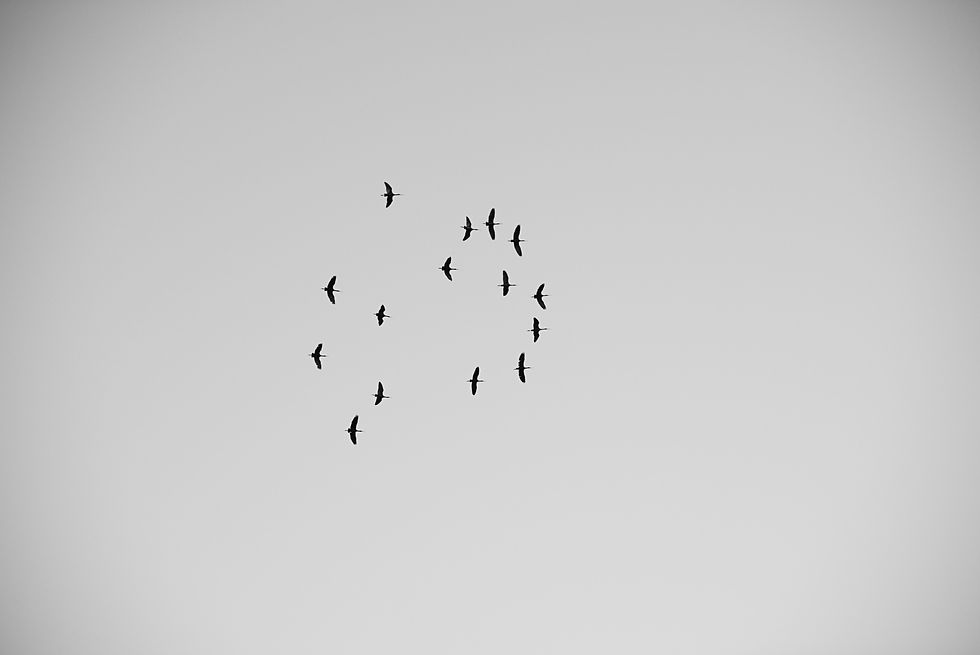
I have the lungs of an ex-smoker, and sometimes I wheeze, often in the morning after a day outdoors. Every now and then, the wheezing is so faint that at first I think it is the call of a distant flight of geese, the dark parody of a favorite sound. The old man rues the image, but it is cherished by the writer. Poetry, the soul’s shorthand, inhabits even (or especially) the darkest metaphors.
Richard LeBlond is a retired biologist living in North Carolina. His essays and photographs have appeared in numerous U.S. and international journals, including Montreal Review, High Country News, Compose, New Theory, Lowestoft Chronicle, Concis, and Still Point Arts Quarterly. His work has been nominated for Best American Travel Writing and Best of the Net.