The Women at the Gates
by Camellia Mukherjee
I was born in Calcutta, India to a posh, Hindu, orthodox family. We lived with the paternal side of my family until I was about five. My family was proud of the men in their household who were engineers, doctors, and lawyers of their times, while the women were just housewives. The women spent hours in the kitchen cooking meals for their husbands, father-in-laws, brother-in-laws — on winter nights, stirring the chicken with bay leaves in yellow curry in a skillet until the meat was tender while on summer days, broiling the hilsa fish with mustard seeds, a Bengali delicacy, to perfection.
Despite all the cooking, our house always strongly smelled like the jasmine incense from the dingy, crooked, roadside shrine under the banyan tree across the street. Our back alley, however, was overpowered by the smell of rotten vegetables and fish bones that our neighbors collected in plastic bags and tossed over the fence into our alley. This neighborly behavior is quite common in Calcutta. Although we weren’t too happy about it, it benefitted the stray cats, crows and dogs who would feast on it regularly. Our four-year-old dog, Mithu, would sneak out to join the gang, until my grandmothers scowled his name and he would run back into the house with his tail tucked under him.
Built by the British, my grandparents’ home was one of the oldest homes in South Calcutta. It stood among the other enormous buildings with chipped walls and broken bricks, and ill-maintained windowsills. But ours was decorated with bougainvillea vines.
Every morning, I woke up to bells ringing, the women of the house chanting and the sweet sound of Shankha, the sacred conch shell usually used during Hindu rituals. Our in-house prayer rituals would begin around 6:45 am and last for two hours, sometimes more. I remember peeking from under my sheets, looking at the clock blinking 6:00, then catching glimpses of Ma walking around the house and quickly pulling the sheets over my head so she couldn’t tell I was awake. Ma was always draped in her white saree with a thick red border, hair parted in the middle in a low bun, vermilion covering her forehead as she carried a copper oil lamp. She waved her palm back and forth vehemently over the ferocious flame, distributing the smoke around the house to purify the air and “rid the house of evil.”
The ritual ended when my grandmother, or Thamma as I would call her, pulled the sheets off of me, tickled my foot, then stuffed a piece of sandesh in my mouth. Every morning it was a different kind of sandesh, coconut (my favorite), almond, cashew and sometimes just plain milk and curdled cheese. I followed Thamma down the stairs to my grandparent’s bedroom, where my grandfather, or Dadu as I called him, would look at her and say: “Ki Ki? Ready?” This was the most important chore of the day, as Thamma described it — sitting at his bedside, she rubbed Dadu’s feet for the next half an hour, while my two unmarried aunts and Ma would retreat to the kitchen to make breakfast.
Dadu lay on the bed, his hands behind his head, eyes closed. Thamma would giggle and say to me: “You know, Pinku, women are unique. A woman’s job is tedious.” She’d sigh, take a deep breath, and continue. “At first, she is a daughter, living the dreams of her mother. Then she becomes a wife, serving every command of her husband. Finally, she becomes a mother, nurturing another young girl to go through the same cycle. You understand?” I nodded.
Thamma was the youngest of twelve children. She grew up learning house chores, spending most hours in the kitchen and laundry room. She told me stories of how her hands would tire from beating the soapy clothes against a bare wooden board to wash them. While her two younger brothers prepared to go to school, Thamma would prepare their breakfast, iron their shirts, and polish their shoes. She used to smile and say, “In a blink of an eye, I fell in love. I married at fourteen and your Dadu rescued me. He takes care of me and I of him, until we die.”
“But you, Pinku,” she continued, “will grow up one day and make me proud. You will go to school and make the money and win the bread. You will be different, right?” I nodded again.
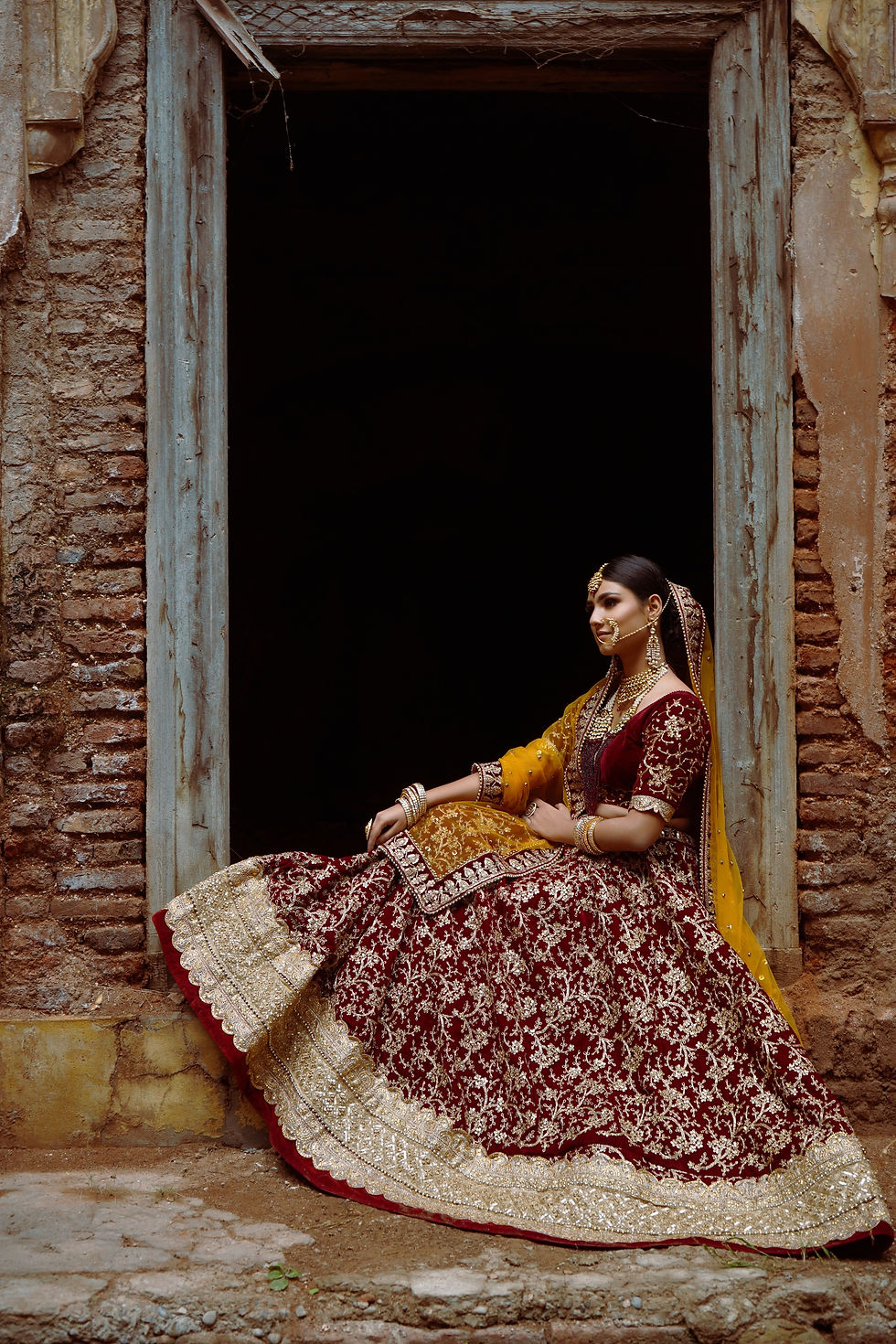
At fourteen, Thamma was married and sent off to live with her in-laws, decked in gold jewelry and a heavy pink Benarasi saree, even before she hit puberty. And she lived up to her wifely duties until the day she died.
Sitting on the hospital bed during the final stages of liver cancer, she made a list of everyday things that would keep Dadu content and would help him cope with her passing. Dadu visited her at the nursing home infrequently. He was sure Thamma would come home. While Thamma was ill, he’d spend most of his days sitting in his room, looking outside the bougainvillea-covered windows. On the day the doctors called to tell him Thamma was getting worse, he lay on his bed and repeated:
“I remember the young, deer-eyed, merry girl I married. Where is she?”
I would sit next him, holding his hand and nod and whisper: “She is here, Dadu. Look….”
Camellia Mukherjee is currently finishing her MFA in Creative and Nonfiction Writing at Western Connecticut State University. She served as the editor-in-chief of an online journal, Poor Yorick: A Journal of Rediscovered Objects, and has published works in Poor Yorick, Limestone Review and The Literary Mainframe.


