The Entomologist & The Philosopher
- Oct 28, 2022
- 6 min read
by Kyle E. Miller
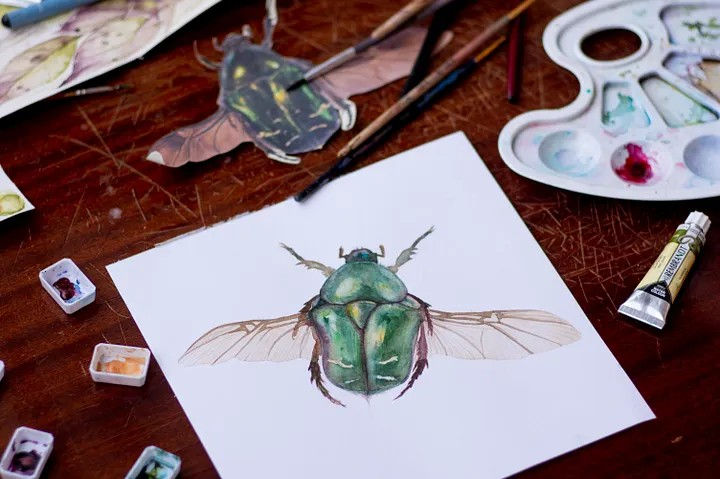
Exhibit A.
One morning in December, a feral cat slipped inside Kyle’s apartment when he left the door open so he could carry all the groceries in at once. The cat saw heat leaking from the open door like an orange paper fan unfolded and ducked inside, hiding herself under the futon. Kyle didn’t notice the cat until that evening, when he smelled a sweet, fetid odor suggestive of mud and feces. He studied signs and symbols for a living and thought he knew where this one was pointing. He discovered the cat in the folds of a blanket stuffed beneath the futon, her teeth bared at his outstretched hand. Kyle was smart; he remembered the open door. He decided never to leave the door open again, not even for ten seconds.
The next day, he bought a case of wet cat food and coaxed the cat into the open. When she emerged, Kyle dropped the can of food in shock. She wasn’t a cat at all. Or was she simply not what he normally imagined when he thought of a cat? Hunger had elongated her body, sure, but there was something else, something unusual about her form that gave him pause. She had the colors of an American shorthair. Vertical pupils. A tail. All the recognizable features of a cat, and yet something was either missing or added, and he couldn’t be sure which. The cat started eating the cat food spilling from the dropped can, but did that prove anything?
Every day over the next week, she consumed her weight in food. Kyle appeased her infinite hunger, and she began to put on weight, though not in proportion to the food she consumed. He bathed and groomed her and let her rub against his feet as he worked on his Treatise, typing through the evening. At night they came close to sleeping together: the cat wouldn’t jump on the bed, but she slept beneath it. Sometimes he thought he could feel her purring through the mattress like a drone concert he had all to himself.
Superstitious about labels, Kyle refused to name her. By spring, she was as domesticated as any other cat, but he continued to suspect there was something unique about her. He counted her teeth and measured the length of her hair. Her claws were sharp enough to puncture a basketball. He dropped her from various heights to see if she would land on her feet (she did) and observed her for hours, noting various habits and behaviors. Every evening as he prepared dinner, for example, she sat on his cutting board on the kitchen counter and licked her ass for exactly three minutes.
What was she doing with her life? There seemed to be no biological imperative around which the identity of the cat could crystallize. Cats are the perfect anarchists, he thought. She saw no borders; limits did not exist in her world. She stretched beyond the laws that held everyone else hostage. What was the cat trying to achieve except the next day? Kyle accepted this as a fact, a kind of lesson. He was fond of epiphanies.
A week later, Kyle tried to carry all of the groceries in at once. When he got to the door, which was closed, he reached for his keys and dropped them, giving the man in the ski mask standing behind him the opening his crime required. The sap fell on his head like a dream, and when Kyle woke up, his apartment had been ransacked. The robber had left the TV and the computer, but the safe was gone, and with it most of Kyle’s savings. Distrusting the abstraction of cash, he kept his wealth in gold bullion.
He looked around. What else?
Oh. The cat had escaped.
The next morning, Kyle took a sip from his half full coffee mug and scrolled through the pages of his Treatise. He couldn’t think of a single word to add to it. The day passed in a fog. Kyle began to wonder about a concussion. In fact, he couldn’t remember what he had been trying to achieve with his Treatise in the first place. It wasn’t that he didn’t have enough words, it was that he had too many, an endless possibility of sentences. He was caught in a loop, like one of Zeno’s paradoxes, trying to move toward a conclusion by completing an infinite number of tasks. There was one specific fact, or lesson, upon which the entire text depended, a distillation of his theory that now evaded him.
He should have written it down.
#
Exhibit B.
In April, a new species of rhinoceros beetle flew into Kyle’s apartment and landed on a chrysanthemum drying in a China vase. The bug had been drawn to the light outside his apartment door, which also attracted house flies, moths, lacewings, and other flying insects out of the night and often, as he opened the door coming or going, into his home. Kyle didn’t mind the occasional insect, but the flies were too much. He unscrewed the bulb from its socket.
In the morning, he discovered the rhinoceros beetle dangling from the red petals of the chrysanthemum by its spiked feet. The beetle’s weight bent the flower almost to the countertop. The vase wobbled when the beetle moved and when it flew, the drone of its wings could be heard from outside the apartment. Kyle picked it up and placed it on his desk, where it immediately attacked a half-empty mug of coffee with its magnificent purple horn. It was like a siege engine, a miniature weapon of war. A moment later, the beetle lifted the mug by its handle. Kyle was ecstatic. Unable to identify the species, he launched into research and a week later named the beetle after himself, in effect claiming the discovery. Dynastes kylius. He would present his findings at a conference in Munich next month.
Two days before his flight to Munich, a young woman dressed in black tiptoed up his driveway and drove a steel spike through the sidewall of his SUV’s four tires under the cover of darkness. The next morning, Kyle found the flier she had placed on the windshield of his car. “ATTENTION — your gas guzzler kills,” it read. “You’ll be angry, but don’t take it personally. It’s not you. It’s your car.” It was signed, The Tyre Extinguishers. They were an activist group out of the UK, an intentionally disconnected network of environmentalists and anarchists who mostly operated in English-speaking countries. There was room for growth. Kyle missed his flight to Munich, and the scientific community never saw his presentation on the aerodynamics of his beetle’s body, which would have had implications for the next generation of aircraft design.
The beetle died the next day.
Kyle laid it to rest on the compost heap, its six limbs folded over its chest like one of the human dead. It’s not a circle of life, Kyle thought, though it behaves something like one. But a circle leaves itself behind. Life was something else, a kind of trick that left nothing behind. A body consumed more matter than it was composed of, beat its will against the environment, expended monumental energies, and filled space with so much noise and motion it made no sense for it all to vanish back inside itself, a complex mechanism for making music, and when the key stopped turning not a single note still hung in the air. It was almost spooky. He looked over his shoulder, hesitant to go back inside the apartment, as if it might swallow him, the white stairs waiting, the red door.
Kyle bought new tires and replaced the bulb in the outdoor light. At night, it threw a rhombus of light over his SUV’s new tires.
He slept poorly for the next few nights, listening on the border of dreaming for footsteps in the backyard. He woke warm and sweating on the fourth night, as if someone had thrown an extra blanket on top of him. He opened his eyes. The door had blown open in the night. It was still dark, probably 3 or 4 a.m. He looked around. Every surface of the room flickered with insects as moonlight and streetlight gathered in the margins between the forked veins of their wings, seen and then not seen as their wings rose and fell to the rhythm of a body at rest.
Kyle tried to sit up, but he couldn’t move.
Kyle E. Miller can usually be found in Michigan’s dunes and forests, turning over logs looking for life, if he’s not in water. He currently teaches first year writing as a Graduate Assistant at Eastern Michigan University. His fiction has appeared in Clarkesworld, Three-Lobed Burning Eye, and Honey & Sulphur. You can find more at www.kyle-e-miller.com.