Coatl
- Aug 23, 2024
- 7 min read
by Barlow Adams
My wife’s tracks in the mud mingled with those of the ducks until I couldn’t tell where anything began or ended. From the house to the creek at the edge of our yard and back, a parade of webbed feet encircling the memory of my wife’s careful, deliberate steps, her stride short, the way people walked when they were carrying something precious.
Her attachment didn’t bother me at first. I thought it could even be positive after we had to give up the baby. Perhaps a selfish thought, to think a brace of ducks could fill that hole, ease that sorrow, or bridge the gap that had formed between us.
The baby’s name was Marie. At least that’s what my wife said. I tried to tell her it was too soon to know the sex when it happened. No, my wife said, her name was Marie. So she grieved for Marie and I mourned the cluster of cells with the abnormally high plasma protein-A count that could have been someone to love. Her heart became a funeral home, mine a laboratory, and neither of us could stand to be in the other’s space for long.
Until the ducks.
The water had been a danger at first, our little River Styx. My wife would fill her coat pockets with stones like Virginia Woolf and stand by the water for hours while I watched through the window above the kitchen sink washing the same dish until my fingers went pruny.
I only had to pull her out a few times. The creek was shallow and even with the stones she had to lie facedown. It was an easy thing, flipping her over. She’d take in as much water as possible, though. Breathe it in like she was smelling a rose.
She’d sputter and cough, pale and cold as Waterhouse’s Ophelia until she spat the river out. Then she’d beg me to put her back. When I refused she’d hit me like a child banging on her parents’ bedroom door after a nightmare. I’d carry her to the house and put her to bed.
I called these Footprint nights, after the poem. It always made her laugh, even if it was a weak chuckle. She had the good grace not to point out I was inadvertently comparing myself to god.
Then the ducks came, lighting on the creek’s surface like temporarily embarrassed angels, a quack-step away from divinity, building nests and filling them with eggs. Which soon hatched, producing ducklings, who in turn became purple speculum feathered youths.
My wife took it as a sign.
She cared for those ducks as if they were her own. The largest portion of our grocery bill went to bread. Loaves and loaves of it were torn, balled up, and thrown to her new family, who gobbled it up as desperately as my wife had tried to swallow the creek. They followed her like a prophet as she wandered our property. Eventually she let them in our house, muddy duck prints through our kitchen no matter how often I cleaned.
But she was happy, and something like happy with me. So I allowed it.
“They love me,” she said.
“They love bread,” I corrected.
“They love me.” She somehow put the emphasis on every word.
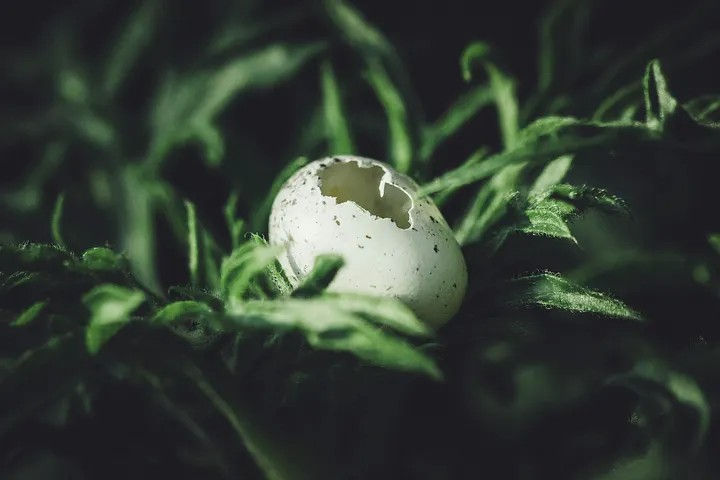
We might have continued on like that, mismatched parents to a hoard of ducks, if my wife hadn’t found the last egg, still nestled in reeds, covered with pieces of shell from other births, whole and white and waiting like a prayer.
It was different from the others. I told her that. About the size of a baseball and leathery like a bat’s wing.
“Not different,” she said. “Special.”
She sowed a pocket onto one of her aprons, carried that egg with her everywhere like a marsupial with a pouch. It grew like a baby.
I thought I was imagining it at first, but soon it was too obvious to ignore. I bought a food scale so we could weigh it. So she could weigh it. She wouldn’t allow me to touch it.
12 ounces. Then a pound. Five pounds. More. As the weeks went by it swelled.
I told her to get rid of it. It wasn’t viable. We could find a new egg. I offered to buy her one.
She refused. I told her I would take it anyway, for her own good. This was my choice too.
When I grabbed the egg she screamed, louder and longer than I’d ever heard, some primal sorrow given voice. The sound was so horrific I let go. She wrapped herself around the egg like a blanket, fetal position, held it to the center of her, told me that if I touched it again she’d skip the stones in her pocket and cut her own throat with a kitchen knife in front of me.
The look in her eye…
I believed her.
So the egg grew. A papaya, a grapefruit, a coconut, and eventually, horrifically, a watermelon.
Still she carried it, hand to her lower back, never a complaint, to the river and back to feed the ducks.
At night I’d remember the feel of the egg against my hands, cold as Christmas, something inside writhing like a storm.
“That’s not a normal duck egg.”
“I know.”
“You know?”
“I know.”
“Honey…”
“I won’t do it again. I can’t. I can’t.” I could hear the horrid wail from before knocking on the back of her teeth, desperate to get out.
What could I say? How could I ask her to do that again?
I stopped asking her to get rid of it, but a dark nameless fear built in me. I wasn’t alone. Once the egg grew to full-size even the ducks wouldn’t go near it. They’d fly to the other side of the creek. My wife still hurled bread to them, some of it making it, some falling on the surface, ducks diving in thoughtlessly after it. September had started to turn the water as cold as the memory of me touching the egg.
They would migrate soon. I wasn’t sure why, but some part of me fervently hoped they’d be gone before the egg hatched. Some part of me almost prayed for it. My wife had asked me to pray with her for the soul of the cells we disposed of. I couldn’t. To what? On behalf of whom? I never prayed. And yet…here, finally, was the urge.
But the ducks were still around when the egg hatched. My wife brought the new baby down to meet its family first thing, before I’d even seen it. I watched the whole thing through the window above the sink. I wanted to run down, like I had when my wife tried to drown herself, but my legs wouldn’t move. Was I too scared? Too guilty? No matter. My blood was frost; my legs were ice.
She continued to go down to the creek every day, just as she had. The baby grew fast. I watched the visits until I could stand it no longer. I slept in the garage after that first day. My wife stayed in the bedroom with the youngling, apart from her daily trips to the creek.
We communicated in notes.
We have to go.
I can’t leave her.
Please, honey, It’s not safe!
There’s left-over meatloaf in the fridge. You should come see the baby. I know she’s excited to meet you.
But I didn’t. I couldn’t.
Until I walked outside one day and the ducks were gone. Part of me wanted to believe the last few had migrated, but I could not hold on to that slippery hope. I knew better.
There were no more duck prints, only my wife’s steady impressions, and beside them the mark left by the baby, long and crooked as a question mark, stretching from the house to the creek bank, wrapping, twisting — undulating.
So I went to see her.
Followed the trail up to the house, past the slough of mud in the kitchen, the blood and duck feathers strewn about the living room, into the bedroom where they waited — my wife on the bed, the baby draped over her, crisscrossing the bed, trying to fit all of itself on our California king.
Its body was twenty feet long, at least, and as thick as my leg, its scales a rainbow so bright it was blinding if the light struck just so. Toward the middle of its back sprouted a pair of duck wings, the perfect paper white color marred by flecks of blood from its slaughtered kin.
If they even were kin. It was difficult to say then what was possible. My cold scientific certainty turned upside down by the thing in my bed.
I couldn’t bring myself to look at its head. Its hideous, beautiful head.
“Marie,” my wife said. “This is your father.”
There was a sound, something between a coo and a hiss, but somehow unmistakably human. I finally met the creature’s gaze — soft brown eyes so much like mine if not for the vertical slit. The face had changed since I first saw it. No longer the chubby, cherubic face of a newborn, the creature now looked like a young girl of six or seven. Sweet except for the impossibly small nose and the scales that dusted the cheeks like freckles.
“Hug me, Daddy.”
When it spoke the voice that pressed past its fangs was clear and confident, no hint of dysfunction. That broke me more than anything. That I still needed to know, that it still mattered. Whether it was that brokenness or the strange hypnotic quality of its voice, I couldn’t help but comply.
The creature threaded itself around me, wrapping slowly, so slowly.
“I’m sorry,” I told my wife.
“I know,” she answered.
The creature was hugging me now. Arms pinned to my sides, I was grateful I didn’t have the choice of whether to hug back or not, to accept or reject her one last time. I’d had enough of choices.
She was so long, coiling around me, head and tail slithering in unison like needlework, like she was knitting me a cold, comfortable sweater. I could no longer tell where anything began or ended.
Barlow Adams is a writer from the Cincinnati area. His work has been selected for Best of the Net, Best Small Fictions, Best Micro, and the Wigleaf Top 50. He is terrified of snakes and making the wrong decision. He doesn’t know what makes those scary cluster holes by riverbanks, and he doesn’t want to know.