The Toss
by Abby Manzella
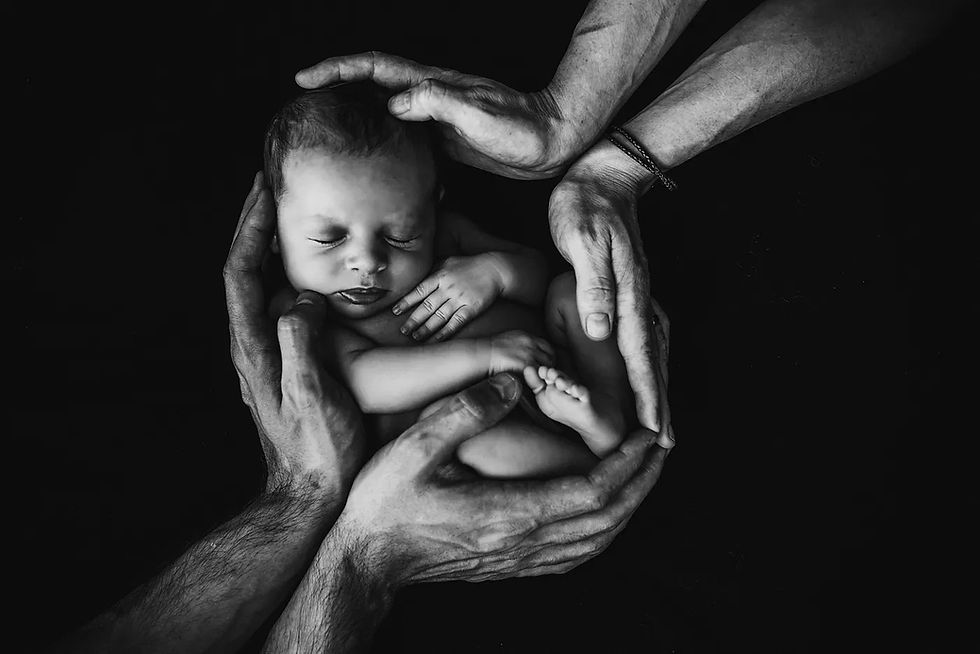
Jake tosses the baby into the air like a pizza — not violently, not angrily like Naomi always accuses him of being. He tosses the baby like the lightness of dough aloft, like a meal of your own making when the spray of flour coats your hands and cheeks — just like he and Naomi did when they were kids and it was Cooking Night at the Cantors’: that’s what his mother called it. His father would throw the dough into the air bellowing Jim Morrison’s “Rider on the Storm,” his mother would line up all the ingredients while swinging her hips, and Jake and Naomi would place the toppings, however they liked — pineapple and mushrooms on his half and broccoli on hers. Everybody together: he the little brother who looked up to everyone else. Jake loved those nights, and the feeling that accompanied them is how he now tosses the baby — not his own baby, mind you, but his sister’s.
The baby has a name, and Jake knows it, something with its own bit of cooking flavor: Sage. He knows babies have all sorts of gender ambiguous names these days, and with those curls it is hard to tell Sage is a boy. His nephew. Everything is so hard to keep straight these days. Not that he cares about any of that gender stuff — let the kid be whoever he wants to be — but it is just one of many things that has confused him since he left home, because they made him leave home.
You’re too much, they said — too much hurt, too much pain, too much worry that he’d never come home again, so when he was sixteen, they stopped letting him come home. Really by that point, the “they” had become Naomi; she was the one who came home from college to take a stand. We release you. We release you from the oh so heavy burden of being a member of this family, Naomi said archly on that final night, like she was freeing him from an enchantment, like she was echoing his words — which she probably was — but when she closed the door in his face, Jake didn’t feel free. He felt let go, plunged into a nothingness where his mother could stand silently by, cowering, while his sister dropped him, like a bad habit, as his father used to say, but now Naomi was saying their father’s words and Jake’s words, too. It was confusing. His head was swimming, and his mother, as usual said nothing either for him or against him. So, his sister was the one to smash his connection to everyone who he thought cared about him. He didn’t feel free.
But today Naomi let him come home. Just for today — to see the baby. Had it really been four years? Was that a lot or a little? It felt like both — the sand in an egg timer and enough to build a desert island.
When his sister spotted him on the bench outside the Y and placed her hand on his shoulder, Jake promised he wouldn’t be a problem.
As soon as Jake tosses the baby, though, he knows Naomi will be mad. In the past she yelled at him for a lot of things that he didn’t see as his fault. But he doesn’t want to rehash all of the ways they got it wrong before, because he isn’t trying to cause a bother. He really isn’t. It’s just that when he held that little boy dressed in all-natural cotton, undyed so as to be as drab as possible to the eye, all he could think of was that his nephew draped-in-tan was a football. He wanted to tuck him under his arm and run away with Sage to protect him from being cast out when he grew older and eventually fucked up. But then, the baby with his own charcoal eyes — Jake thought all babies had blue eyes — giggled. It lasted for just a moment, but it was quiet and deep — the start of a song meant for him. He couldn’t think about the other eyes that were burning a hole into his back. All he could do was laugh back. Sage made him laugh, and he wanted Sage to laugh again. So up into the air Jake tosses him, and he hears the gasps around him, even though he knows he is completely in control, and what is everyone’s problem anyway?
He knows what he’s doing.
His own father had thrown him into the air in just this way many times when he was a child, and sure, Jake’s father no longer speaks to him, but his father no longer speaks to anyone else in this family either. His father had left them all. No more Cooking Nights at the Cantors’, no more catch in the backyard, no more flour floating gently to the floor. Still, Jake knew he was the only one to blame. Everything had shattered because he brought the world tumbling down around all of them with his unreliability, his lying, his stealing, which all really boiled down to the pills. He knew; they’d all told him time and time again.
But that was in the past, and he couldn’t think about that now.
Here Jake has a chance to start things anew with this giggling baby who doesn’t glare at him like his sister or turn his eyes away from him like his mother, and he wanted to extend that moment of laughter. He wanted to give that kid a feeling that Jake had long missed.
That sensation, when you are tossed into the air so unexpectedly, at first, centers a pit of fear in your stomach so strong and fierce like you’ve never felt before, but then it’s followed by this joy, also brand new, when you recognize that someone is going to catch you, their arms reaching upward. Nothing is quite so good in all the world, and then, ever after, you expect to be grabbed and pulled to safety each time you feel fear in your gut. You expect that ecstasy will follow each anguish because long ago your father flung you away from him and then seized you back from despair into his arms. So, you chase that feeling somewhere else when you can’t find it at home, but then again, maybe you couldn’t find it at home anymore because you chased it elsewhere. Whichever way, you’ve been gone for quite a while, and everyone refuses to catch you anymore. They don’t even embrace you when you arrive. Isn’t that what family is supposed to do? Aren’t they the ones who are supposed to save you?
As Jake reaches his arms toward his skyborne nephew, both of them laughing, he knows that this time it will be different. He’ll prove himself to them; he won’t be a pain. And this time, he’s sure, they’ll catch him.
Abby Manzella is the author of Migrating Fictions: Gender, Race, and Citizenship in U.S. Internal Displacements, winner of the Society for the Study of American Women Writers Book Award. She has published with Literary Hub, Catapult, Flash Frog, No Contact, and Colorado Review, and she has read her work for Micro, a podcast. Find her on Twitter @AbbyManzella.


