Parable of the Fishbone
- Jan 8, 2021
- 3 min read
by Star Su
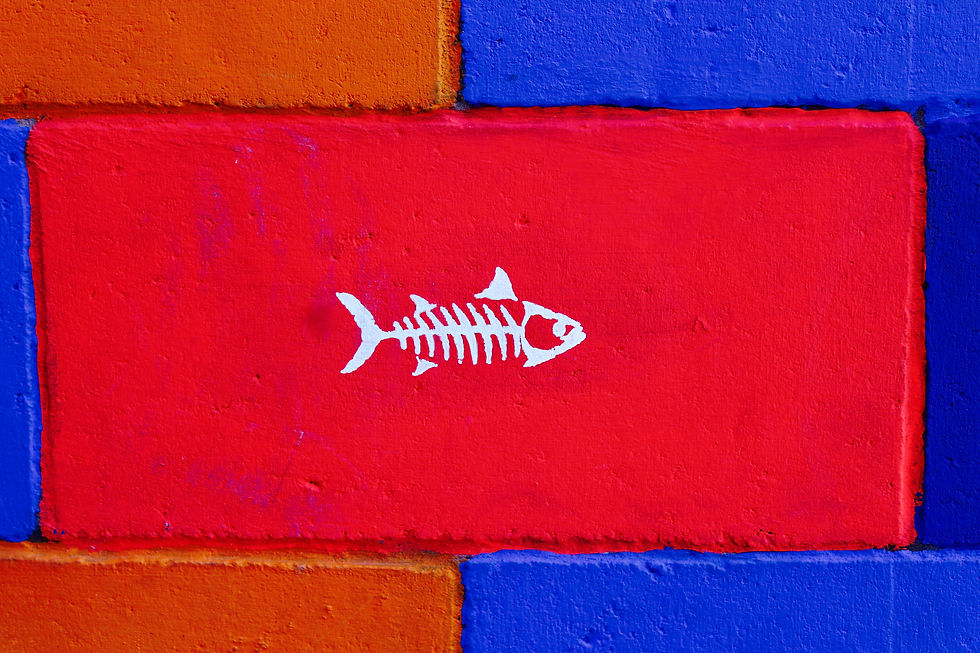
Apo always said to never laugh and eat fish at the same time. If you swallowed the bones, they could kill you. We nodded and moved our mouths like grasshoppers: delicate, leaving nothing behind but translucence. After dinner, we divided the skeletons equally between cousins, made a contest of folding the spires and beams into new creatures. If the bones had a disagreeable vertex, we softened them with our spit. When they hooked onto our tongues, we learned to give communion to the metallic taste of death.
First, it was Ya-ya who swallowed one by accident. It was no longer than his knuckle and threaded a stem onto his throat-apple. He hid his new voice, carried it like a shell: artillery or conch, a fragile valence that pierced the fake glass plates our mothers polished, the windows our fathers sealed with superglue each winter, and the lightbulbs thrummed like ginger ale. We grew used to the cusp of his paper-thin hands on our shoulders, their rhythm on our skull when we didn’t behave. After he tucked us into cocoons and sardines in bed, he watched jing ju. The operas wove a curtain of air, flexing and unspooling. We held our breath as Ya-ya touched his throat, tested its ripeness.
Apo was next. That day, we didn’t get the joke in Chinese so she told it again in Cantonese, Shanghainese, cycling through dialects, releasing the vowels like a new kind of rain. We laughed because our parents did, careful to bite our tongues, to stop the bones from stitching us new throats. It was only Apo who didn’t follow her own advice and laughed while eating the sea bass, a buttered fin slipped past her tonsils.
The American doctors coated her insides glow-in-the-dark milk, crawled in with a flashlight. The metal tray rattled with only the bones of fruit: sunflower kernels, watermelon seeds, longyan pits. Did you really swallow? they said. If we can’t find it, it must not be there.
Our parents take Apo to a Chinese doctor. We trust him because he’s on a health show we all like to watch, where it turns out doctors are more dramatic than opera artists. They toss their voices in brightly lit rooms, bind their patients in striations of syrup and woodear. They teach us all the ways a body can rot. Stroke, sepsis, even sitting for too long. After they heal a man who has swallowed flounder, whose bones could be used as knives in another life, our parents call the number that flashes after the show.
He feeds Apo shots of vinegar followed with sticky rice, seals her throat with loquat and pomelo peel. Still, the bone does not dislodge. It’s a part of you now, the doctor says. He warns her that it could flee her body anytime, from any of her holes, possibly even forging its own. Apo says she understands its needs. After all, this is what having six children was like.
We reason that Apo was trying to plant new children so we string the seeds from the surgery into a necklace and argue which part of the backyard is best. Our mothers tell us that even if we succeeded in planting a ring of fruit trees, it would be many years before they bore fruit.
We don’t believe them. Why be a mother to anything?
The seeds boil and seethe in the dirt. Ya-ya sings with them, his voice just a trickle at first. Then, it cuts open, cold concentrate like water from the high mountain springs in Nantian, full of wriggling fish and the chattering monkeys Apo said were clever, clever, thieving for their hungers. The roots respond, charging through the ground like lightning, white film stretching. The current surfaces fossilized shells, fragments the earth reverberated from its own throat.
Apo comes into the yard, watering the ground with leftovers. Fish spines, egg shells, soft silver of gum wrappers. We squat, watching earthworms illuminate channels, how they make passage through a body, its bones, into new dark spaces.
Apo doesn’t sing with Ya-ya, even though her voice is hewn from silk. We touch her neck and feel two pulses. We remember that every creature is made from bone, from hunger buried, from a socket of seeds, swallowed again and again, landing each time further and further from our sight.
Star Su grew up in Ann Arbor and is currently an undergraduate at Brown. Her fiction is forthcoming in Waxwing, SmokeLong Quarterly, Passages North, Citron Review, & elsewhere. This is her first published piece of fiction.