Macro Minds, Micro Talks with Mandira: Writer Emily Rinkema
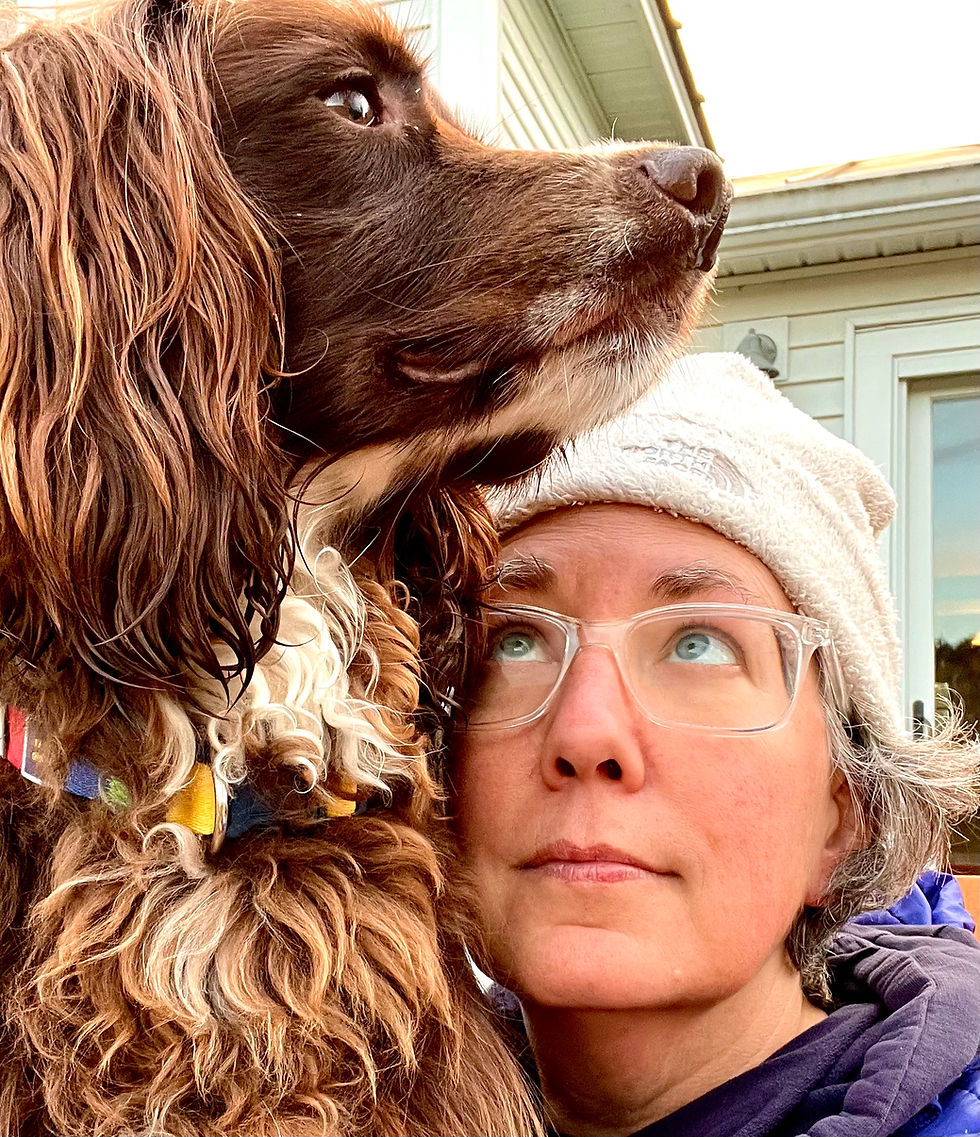
Interview by Mandira Pattnaik
Emily Rinkema lives in northern Vermont. Her stories have recently appeared in Cutleaf, Moon City Review, Milk Candy, and Wigleaf, and have been selected for Best Small Fictions, Best Microfiction, and Best American Nonrequired Reading anthologies. You can read more at https://www.emilyrinkema.com/ or follow her @emilyrinkema.
Thank you, Emily Rinkema, for joining us for a brief chat. Congratulations on winning the 2025 Moon City Short Fiction Award and the 2026 Vermont Writers' Prize. The first thing that catches attention about “Dead Mother Card” is its title. I’m excited to hear how the title came about.
Thank you! I’m so excited and still a little bit in shock that I’m going to have a real collection of stories out in the world. The title comes from a story that was published last year in Fractured Lit about a woman whose mother died when she was a child and so she plays her “dead mother card” throughout her life, with varying levels of success. So many of the stories in my collection have mother issues…so it felt like a good title. The collection has quite a bit of dark humor, and for that reason, it also felt right. My mother died when I was 15 and it has really shaped so much of my life in ways that are still unfolding, good and bad, so this collection is part therapy, part tribute, part exploration, and part exploitation, I suppose.
A collection that is “part therapy, part tribute, part exploration, and part exploitation” sounds incredibly interesting. Thank you for sharing this background. Readers who are also writers would love to know from you how to go about assembling a collection.
Assembling the collection was actually really fun. I love to organize, so I took a complicated, hands-on, executive-functioning approach to the whole thing. I made an index card for every story, and then coded them—word count in upper right corner, POV in bottom right, and then I added colored dots based on common themes or motifs. So all stories about grief or loss got a yellow dot, dead moms got a blue dot, funny or absurd stories got a green dot, etc.…and this helped me make sure that the collection felt balanced and that I didn’t inadvertently put three stories with dead moms in a row (that’s a lot of dead moms…).
I’m sure this will help a lot of writers out there. In a 2013 interview, you mentioned: “Maybe because I spend so much time as an English teacher looking at language and sentence constructions, I find myself drawn to a genre that demands such intentional craft. Each year I tell myself that I will finish the novel…”. I’m curious about your novel. To present my own case: When I drafted my novel, I had to unlearn some of my flash fiction skills. Do you feel that this microscopic focus on “intentional craft” (as essential for micro or flash fiction) aids or hinders flash-fiction writers who might want to attempt a full-length literary novel?
This made me laugh, because 2013 was so long ago and I remember when I was working on that novel! Technically, I finished it, but no one should ever have to read it. And I think it taught me that I don’t really want to write another one. Flash is a pool I jumped into a few years ago, and I don’t ever want to get out. It brings so much joy to me, both writing it and reading it. And there’s no community in the world better than the flash community!
I do think there’s truth to the collective shortening of attention spans for readers, and though this gets a bad rap, maybe it’s not all negative. I think more and more people are discovering flash because it’s not a commitment. It’s like going to a tapas bar. You’re willing to try things you might not otherwise order because they are tiny (and usually free!). Despite all the evils of social media, it’s really a great platform for flash.
I don’t think writing flash has to be a stepping stone to longer work—it’s an entirely different genre, and I hope we are just at the very beginning of its popularity in mainstream culture!
Love this term “rage-write” you used in an interview, and yes, many of us have done that at least a few times. You mention how a man you ran into “decided to explain AI to me. It was sort of the last straw…” and how the result of that sudden encounter was a first draft of your award-winning story “Huff and Puff”. Would you like to share your thoughts about AI? Particularly how AI is encroaching upon creative space?
My thoughts about AI are complicated and conflicted and evolving. As a creative writer and as a human, I hate everything about it. I hate that we are in a world now where we don’t know what’s true, where we can’t even trust what we see or read or hear. I fear for what this is doing to our children, who won’t know a pre-AI world. They are growing up in a time where they know they can’t trust their own senses. Long term, what does that do to us? And of course, I hate every part of AI in the creative world.
I hate that in my editing job, I read submissions with skepticism, that I question authenticity when a turn of phrase surprises me, that I have to Google-stalk authors I haven’t heard of to find out if they are real people. I hate watching what it’s doing to this lovely online writing community and how innocent/honest writers are going to get caught up in what seems like a witch hunt at times…it all feels so scary and dirty and dangerous. I feel so lucky that I began publishing and establishing a reputation before all of this started, and I fear for young writers trying to break into the world, having to prove originality.
And the other side of it all, is that in my professional life as a public educator, I see the benefits of AI (and yes, the drawbacks/dangers, of course). For example, we have more and more immigrant and refugee families moving into our district, and AI allows us to communicate, to make our content accessible, to celebrate our learners’ strengths that before were limited by language differences. We have students who have specific learning disabilities that make communicating the complexity of their thoughts challenging, and for decades, we made assumptions about their thinking because they couldn’t express those thoughts through writing. AI has changed that, allowing them to share what’s in their heads. We have students who struggle with input and processing, and using tools such as Notebook LM has helped them learn material that was off limits before because now they can access the content and access tutoring that wasn’t available to them. If we use it well (and I acknowledge that that’s a gigantic “if”!), AI tools can help us provide equity of access to high-quality learning for our most marginalized students, and that’s hard to hate.
AI is a scary topic to discuss because we all have such visceral and extreme beliefs and experiences, and it’s so easy to judge each other and jump to conclusions. I have found the easiest way for me to make sense of it right now is to separate my personal/writing views (which are that AI is evil and I will avoid it at all costs!), and my professional views (which is that we have an obligation to our children to figure out how to co-exist ethically).
When I learned that you’ve been an English teacher, I recalled how my High School English teacher encouraged me numerous times to read my essays in front of the class as an example text of the highest order. To me, that was proof I could write better than at least fifty others. Please share your experience as a teacher to young minds, and if you remember, about your own English teacher decades ago.
I didn’t love school, but had a few teachers that really pushed/inspired me. I think the most influential was actually a shop teacher who taught silk-screening. It was the only heterogeneous class in my high school (all the rest were leveled/tracked), and the way he was able to differentiate for us all taught me more about equity (or the lack of it in other parts of my school) and the importance of high expectations for everyone.
I wish I had been immersed in the world of flash in the early years of my teaching, as I think it would have been a great way to get students hooked on the wonders of language. I keep waiting for someone to publish an anthology for students, with engaging flash stories and lots of prompts that teachers can use in their classes…I think it would be really popular with teachers, who are always looking for short pieces of writing that demonstrate elements of literature or aspects of craft. I know more and more middle and HS teachers are using flash in their classes, but they often have to search through other collections or journals to find relevant and appropriate stories. Having a curated collection would be incredible!
In your most recent piece, “The Night the Mongols Arrive to Sack the City,” published in trampset, the narrator is wearing a “Dogs are My People” hoodie. How do you approach blending dark humor, ordinary mundane details, and such surreal, jarring elements as Mongols in a hotel lobby, without losing focus?
Such a good question…and I’m not entirely sure of the answer. I think I have always been really drawn to dark humor, and humor in general, and so much of humor is about juxtaposition of the expected and the unexpected. My uncle Chuck was a huge Monty Python fan, and introduced me to that type of comedy when I was really young. So many of those sketches take something entirely ordinary and then insert the absurd (the dead parrot, the ministry of silly walks, or conversely, take the extraordinary and bring it down to the most banal, like much of Life of Brian or skits like the Spanish Inquisition). I think the key to the success is figuring out how to make the surreal feel real, and how to drop a reader into a world that is just a little bit off without allowing them to stop and say, wait a minute…that couldn’t happen. Sometimes, it’s about just believing it as a writer, I think, and not trying to overexplain “how” something would be possible.
One of my favorite funny flash examples is Michael Czyzniejewski’s “We Could Also Dig a Hole” from Flash Frog. It’s dark and so so funny because of how he takes something entirely possible and relatable and then just ratchets up the absurdity. Timothy Goodwin is also so skilled at this type of writing, turning the ordinary on its head, or imposing ordinary on the absurd (see “They fired up the laser” in Dishsoap Quarterly). I usually can’t get enough of the stories in journals like Okay Donkey and Hex and JAKE and Split Lip because of the way they make me laugh and then punch me in the stomach.
I'm sure you agree with the Hemingway quote: “If a writer stops observing, he is finished. Experience is communicated by small details intimately observed.” Details and intimate observation are thoroughly evident in your work. Any advice on the writing process others might find helpful?
I think that there needs to be a balance between general and specific when writing flash. There are times when you don’t want to give the reader a clear visual, because you want them to bring their own. Being overly descriptive can sometimes take me out of a story when I’m reading, because I get too caught on visualizing what the author wants me to see and stop paying attention to what’s beneath the words—or if they are super specific about a detail and I’m not familiar with the item or the detail or the reference, it can pull me out of the story. An example might be if you’re saying that your character has a book on their bedside table, you have the choice of just saying “book,” which allows the reader to skim over it as a background detail, or giving a type of book, say a “dog-eared paperback,” or an “unopened self-help tome,” or, being super specific and giving a title, “a first-edition Atlas Shrugged.” Many of my writing teachers would have told me to be as specific as possible, but that’s not always the right choice…while the third option is the most precise, it also has the greatest chance of pulling the reader out of the story (unless the story is about the book). Anyway, I think that’s one of the biggest challenges for me in flash: trying to decide what is necessary to the story I want to tell and what is going to distract readers from the center.
Writers are more than the sum of their body of work. You’ve been a prolific writer. Who is your biggest supporter at home? Any fan mail/interaction through the years you particularly recall?
That’s easy, and maybe a bit cliche! My husband, Bill, is my biggest supporter in all ways, not only in being a champion of my writing, but in that he makes me laugh all the time and gives me the space and confidence to take risks with my writing life. And he does all the cooking.
As for “fan” mail or interactions, I have to say that I read every comment I see and so appreciate when readers reach out to let me know that they connected with a story in some way. One that I recently read out loud to my husband was a person I don’t know on X who had seen the announcement from Moon City Press and wrote, “OMG, Rinkema has a collection coming!” and I wasn’t tagged (a friend sent me a screenshot) ...there’s something unbelievable still about knowing complete strangers are reading what I write…and to be referred to by last name as if I were a real writer…it felt strange and amazing.


