Good Girls
- Feb 11, 2020
- 11 min read
by Nikoletta Gjoni
Vlorë, Albania, 1946
Ermina stared at her lace socks sitting snuggly at her ankles like little crowns above her feet.
She was too short to reach the floor and even then, at seven-years-old, she felt her little heart thrum against her chest in anxious anticipation.
Her mother’s hand fell tenderly on her shoulder.
“Are you excited?” she asked with a laugh.
“Yes!” Ermina chirped. She was excited but didn’t know how to vocalize that she was also nervous, but not the scared kind. It was a different kind of nerves that ran through her, making her palms warm and slick. It wasn’t like when her father raised his voice at the dinner table or when she became hot and sweaty under her blankets when it stormed outside.
Waiting in the long hallway of the music school, Ermina heard the swell of music behind closed doors. Chopin rang out from a door far down, floating through the space like a ghost haphazardly making its presence known. After it stopped, she heard a poor imitation of what the teacher had played just a moment ago.
A woman was making her way down the hall towards them, her heels fighting against the sounds of the piano.
“Mrs. Gjika, I presume?” She held out her hand for Ermina’s mother, grabbing it limply as if she changed her mind midway to receiving the handshake. “Thank you so much for your interest in providing music lessons for your daughter. This way, please.”
She led them down the hall, past rooms where cymbals crashed, pianos groaned, and trumpets wailed. A sharp right turn and they found themselves inside a sparsely furnished office.
“Please…” the woman’s voice trailed off and she pointed to two chairs in front of a desk.
Ermina sat down and folded her hands on her lap, her fingers toying with the lace trim of the dress her mother had made for her first piano lesson. She remembered to keep her back straight like the adults did; like her mother sat.
The women began to chatter and Ermina’s eyes scanned the room, her eyes landing on a post, tracing the outline of a Beethoven silhouette at his piano. Next to him was a picture of Albania’s dictator, Enver Hoxha, staring down at her, a stern look on his face, eyebrows furrowed creating wrinkles in his brow. He had the same look Ermina sometimes saw on her mother’s face when she was learning a new piece of music at her piano.
Ermina’s ear picked up the words “family history.”
“I see here in the forms you filled out that you don’t have any contact with your father. Can I ask why not?” She smiled when asking the question, but the smile looked more like a grimace a child paints on a two-dimensional face; crooked and shallow.
“I haven’t seen him in years,” Ermina’s mother answered as she straightened her back and shifted in her seat a bit until she was sitting on the edge.
“Is that because he is no longer in the country?” The director flipped a few papers in the folder she had opened on her desk and pointed to something written down. “It says here that your father left the country just as there was going to be an arrest warrant made.” There was no question, only a statement. She looked at Ermina’s mother with that same smile slowly melting off her face. Her lipstick was dry and sat unevenly along her lip lines, bleeding out a little as if her lips had tired of catching families off guard day in and day out.
Ermina’s mother sat still in her seat, her lips also frozen into a tightlipped smile.
“I suppose that’s true. Yes. What of it though? Like I said, I don’t really have a relationship with him. I haven’t for years. I have no idea where he even is, if he’s even alive.”
The music director closed the folder on her desk and folded her hands over it.
“I’m sorry, Mrs. Gjika, but I’m afraid your daughter isn’t a good candidate for our school. I’m sure you understand. I can give you a couple of recommendations for retired teachers if you’d like. A few give private home lessons.”
Ermina thought about evenings with her mother at her piano, hands gliding over the keys, eyes closed, her memories of long-ago lessons taking the place of sheet music. Ermina would watch her mother and sometimes doze to the sound of music she wasn’t familiar with.
Music she wanted to become familiar with.
“Thank you for your time.” Her mother grabbed her purse and stood up a little too fast. She held her hand out for Ermina to grab.
“The recommendations?” asked the director.
“No, thank you.”
Ermina walked quickly to keep up with her mother’s pace down the hall. They walked past posters on the walls, past doors closed to them. The music they heard while sitting and waiting had stopped, and the space was instead filled with her mother’s heels clacking against the sterile tile floor. Through the double doors and out onto the street with nothing to show from the visit, Ermina found herself angry with a grandfather she had never met before.
1955
After it was over, Ermina felt both euphoric and pained. Beside her, Berti breathed heavily and let out a groan.
“Wow,” was all he said before turning to look at her. He seemed so much older in the moonlight, naked. He had just turned twenty-years-old and beside her still teenaged body, he could’ve been as old as her father. All men past a certain age seemed the same to Ermina.
“Are you okay?” he asked, propping himself up on his elbow.
They had just had sex—the first time for Ermina—but she suddenly felt shy. She pulled her shirt over her chest and felt her face grow hot. She hoped it was dark enough for him to not notice. She was touched at his concern for her.
“Mhmm.” She turned her face up to look at him. She was smitten before. Now, she was in love. She was embarrassed to admit it to herself, but she felt her chest throb and her body felt as if it had caught fire. She had never felt more adult, more confident in her life. And at a mere sixteen-years-old.
Her mother had gotten married at sixteen, but this felt different. Her mother’s arranged marriage was a circumstance she couldn’t escape; a forced adulthood she had to make herself ready for. Ermina chose this for herself and in having that choice, she felt as if she had truly reached maturity in a way that her mother would never understand.
As the sense of euphoria began to fade, it was replaced with worry of the time and of getting back home before her parents grew anxious.
“I have to get going,” she said while throwing her shirt on and searching for her skirt. Berti handed it to her.
“Hey.” His voice, deep and gravelly for a twenty-year-old, pulled her to him like gravity. “I care about you. You know?” It sounded like a question masquerading as a statement. Ermina’s chest tightened so much she thought her lungs would collapse. And what a way to go it would’ve been.
She pressed her forehead against his shoulder, hiding her smile. She simply nodded.
That evening, her parents ate in silence at the dinner table, not an eye rolling her way to notice there was a flower budding inside of her with roots reaching down to her feet. She had always heard that it was noticeable when someone lost their virginity, but now, she was beginning to think it was a scare tactic to keep women in line.
Over dinner, she felt victorious.
Growing up, she had repeatedly been told of what proper behavior was for a proper girl.
“That’s a loose girl right there,” Ermina’s mother would say of a neighbor who was always found walking around the neighborhood or laughing loudly among a throng of people. “No one person has that many friends.”
Good girls had curfews.
Good girls did well in school.
Good girls married at an appropriate age as virgins.
Ermina couldn’t think of a single story where a good girl had sex secretly with an older boy to have it end in marriage.
“Boys only want one thing,” her parents would say whenever a boy looked her way. But what if the girls wanted it too? Good girls didn’t make such adult decisions on their own and find themselves enjoying them.
In bed that night, Ermina replayed the evening over and over in her head, finding the sensation both new and old. Her body felt both pain and exhilaration. It was like when she rode her bike down a hill as a child but crashed into a wall.
That feeling of freedom, of her stomach flipping, of a weightless body, only to end with a jolt and her private area filled with a numbing pain as the bike’s handlebars folded into her belly. She wondered why nothing in life was neither this nor that and why fleeting moments of fear always overshadow the long-term impact of joy.
She stared at the ceiling, hoping the tears would sit below the surface. Instead, they filled and filled, threating to drown her until they slowly spilled over the sides of her face. Her body ached but she couldn’t tell if it was the aftermath of intercourse or if it was her emotions manifesting.
1957
Ermina’s mother was frantic.
“How could you? Oh my god. Oh my god. Walk back now! But don’t put that foot down just yet.”
Ermina hopped back to her bed and stood there wobbling until her mother brought her left shoe for her to put on.
“Ma—this is ridiculous, you know that, right? It’s just a stupid superstition.”
“It is what it is, and we are what we are, and we are creatures of habit. Are you willing to take the risk of starting your life off with a curse?”
Ermina bent down to put her shoe on.
“Have I been dead this whole time,” she asked, “if my life is just starting now?” Her mother ignored her.
“Stop!” Her mother suddenly ordered from across the room. At first, Ermina thought it was in response to her question, and she was briefly happy to have her mom backpedal and explain what it was that she actually meant. Instead, her mother had leapt up at the sight of Ermina fiddling with her shoe, struggling to secure the strap.
“Sit down. I’ll put it on for you,” she said, as if she no longer trusted her daughter to handle the simplest of tasks.
Ermina’s wedding dress made her feel hot and itchy. It was unseasonably warm out for spring and she just wanted to get the ceremony over with. Somewhere on the other side of the door, Berti waited to make her his wife. She smiled thinking about him all dressed up waiting for her. She smiled that she had become the exception to the good girls rule.
“There you go,” her mother panted from the floor. She was pink in the face from bending over. “It’s on there good and tight. No shoes falling off tonight,” she said with a smile.
Ermina remembered getting into her mother’s high heeled shoes as a little girl. She’d curl her toes to try and keep them on, though one would almost always fall off and she’d find herself walking across a room with one bare foot. It wasn’t until she was older that her mother caught her walking across her bedroom with one shoe on and one shoe in her hand.
“What are you doing? Sit down and put that shoe on,” her mother demanded. “Are you trying to test your luck?”
“Ma, what are you talking about?”
“Don’t let me catch you walking with one shoe off-on again. Do you want to make yourself a young widow?”
“Ma. That’s the dumbest thing I’ve ever heard.”
“It might be. But just do it for me and put your shoe on.”
The two steps she had taken in her wedding dress with one shoe off had reminded her of that moment. Ermina heard her mother whisper a few quick prayers that her daughter have a healthy marriage and many children, but she pretended to not hear it. She looked at her mother and wondered how a musical mind that dissected the mathematics behind classical compositions navigated daily life by way of superstitions.
“Ma. Why didn’t you ever give me the piano lessons yourself?” The timing of the question was all wrong but Ermina needed something from her past to tie into the present and quickly approaching future. Sitting on her bed in a lace dress, she was suddenly back at the music school with her mother, waiting for the director to come out.
Her mother moved over to sit closer to her, tucking a loose strand of hair behind her ear.
“I don’t know. I’m not good at teaching. I’m good at doing. I thought it would’ve been better for you to go to a school. To have that experience.” She smiled wistfully while her eyes focused on the wall behind Ermina’s head. “I don’t know,” she finally said. And then added softly, “I’m sorry.”
1975
With each year that passed since her husband’s unlawful imprisonment, the home felt less like a home and more like a holding cell.
Waiting. Waiting.
Waiting for life to resume. Ermina’s boys grew older and she wished that was all she needed to sustain herself. What kind of mother found halfhearted joy in her sons growing out of their childhood phase and trying on the size of adulthood? What kind of mother kept her joy at a distance?
Ermina wished Berti was back home with them. To watch them grow, to guide them to one day becoming fathers and husbands themselves. She felt her powers as a mother diminishing with each year they aged; with each inch they shot above her.
In her greatest moments of loneliness, usually in the middle of the night, Ermina wished she had a daughter. She’d relive moments with her own mother—the bickering, the back and forth, the moments of frustration mingled with the moments of joy shared between two women. A daughter kept her mother in the game longer than a son ever would and Ermina’s time was running out.
A good wife obeyed her husband.
A good wife found solace in keeping the house in order.
A good woman found solace in being a mother.
But the nights grew long—the years that much longer—and Ermina wished each night before sleep touched her that she had kept both shoes on throughout her life; that she had waited longer to be married off as a virgin. So many small inconsequential decisions that now seemed to have come back full circle and settle around Ermina’s neck like a loosely fitted noose.
1989
Ermina sat below the plum tree in her front yard, the walls creating an island in the city. Behind her, the house sat quietly with darkened windows that peered out solemnly at her. In the spring and summer months, Ermina sat outside until the sun went down, and even then, sometimes long after. She’d wrap the quiet around her like a shield and find herself lulling in reminisces of when the property had a husband and children and animals.
The chaos of a house filled with life was underrated.
There was a chill in the air hinting at another season sitting just around the corner. Ermina had grown to love those gray areas—the brief state of limbo, the threshold between spring and summer, fall and winter. It was a moment of suspended time and she felt herself hover between the past and the future that was always hurling towards her.
She always took this time under the plum tree to carve out the mental space for dedicated thoughts. She remembered time with her eldest, Jusuf. She remembered the way Dritan clung to her after their father was taken away—the way the boys clung to each other.
Ermina thought of her husband before he was a husband, before he was a father. When he was twenty and unscarred and convinced her that she was different from the other girls he usually fooled around with.
“You’re one of the good girls,” he’d said the night they first slept together, right before she opened herself up to the possibility of being both good and human. Before she could imagine a mother being sexual without the thought of children.
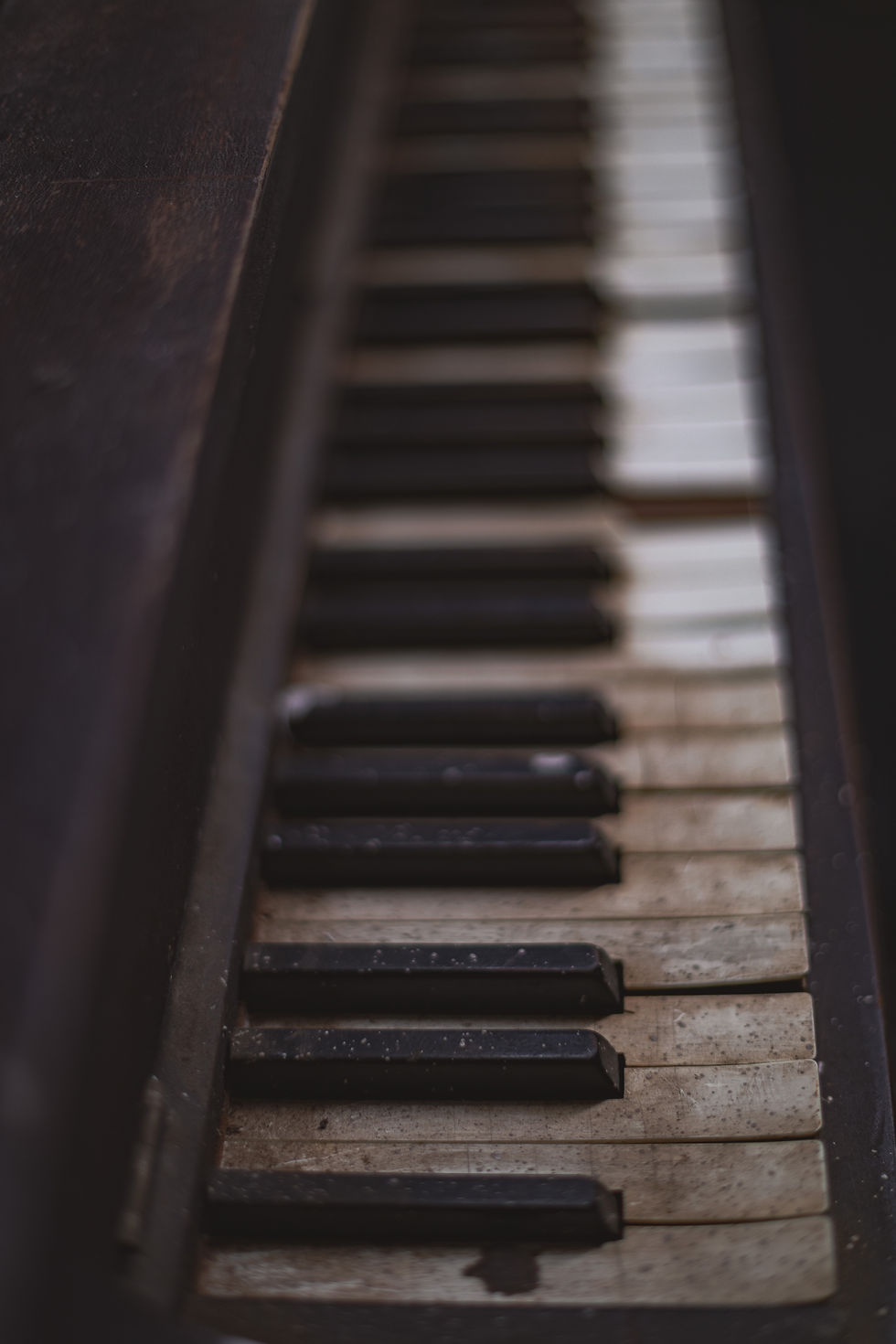
Often, as she’d make her way back inside the house, she’d walk past her mother’s inherited piano and think of her. Sometimes she’d walk right past it. Other times, she’d take a seat and rest her hands on the keys. With eyes closed, Ermina heard her mother playing Chopin, the swell of music clear in her mind as her hands stood still, wishing after all this time that she had learned to play.
Nikoletta Gjoni is a fiction and creative nonfiction writer living outside of Washington, DC. Her work can be found or is forthcoming in Kindling Volume III, Cleaver Magazine, Rhythm & Bones Lit, Jellyfish Review, and Riggwelter Press, among others. Her work has been previously nominated for the PEN/Robert J. Dau prize and for Best of the Net. View her other publications at www.ngjoni.com.