And Then I Found Myself
- Mar 12, 2021
- 7 min read
by Joe Squance
drunk and forty years old, standing alone in the sitting room of my former best friend’s childhood home, decades after he’d last lived there, on the night following his mother’s memorial service. The house, for sale, was empty; the front door by chance unlocked. In I went, sloshing alcohol and full of fear.
I expected the house to feel small but was struck anyway by its smallness—the rooms were tight, the doorways narrow. I knelt and swept my palm across the carpet in wide arcs hoping to dislodge the spores of old memories, but nothing of me or my friend or his mother seemed to be left in that place.
I roamed freely, haunting the bedrooms, the living room, recognizing nothing. The kitchen was dark and unfamiliar and I suddenly couldn’t remember having ever eaten a single meal inside the shelter of that house. My mind was a clean paper plate. I felt silly and made to leave, even knowing that none of this was what I’d really come to see.
The service had been a beautiful one. My childhood best friend spoke with humor and anguish about his mom, about her adorable quirks, about the times when he had disappointed her, about her equanimity, her grace. His father spoke with love and gratitude about the friends who had appeared at their house—not the house I stood in—during the long home stretch of her illness as her body slowly consumed itself. It was a comfort, he’d said, for someone else to see the things that he was seeing every day. They played “This Door Swings Both Ways” by Herman’s Hermits. They read some poetry I couldn’t quite keep my mind on because I was still thinking about what his father said and everything it seemed to contain.
At the reception that followed, my friend was mobbed. I watched him from across the room but never got close. I spoke to one of my high school teachers whose name I couldn’t recall. “Still running?” he asked me. He’d seen an essay I’d written for Runner’s World that my mom must have posted to Facebook. His teeth and nose seemed too big for his head. “I only run when I’m being chased,” he said and laughed. “I am being chased,” I wanted to say, thinking of the moles slowly turning black on my calves, the tender spot near my armpit like a bruise on a pear, of all the dark crevices inside my body where anything that wanted to could crawl in and hide and metamorphose. Become more me than me. I left the reception soon after.
Too tired to eat, I went to one of the lower-profile bars and sipped a whiskey Coke in a corner booth. I had an 11 pm flight back to another city where my wife and daughter were waiting for me to come home. My hands shook as I read their texts to me: can’t wait to see you, and a picture of their wonderful faces.
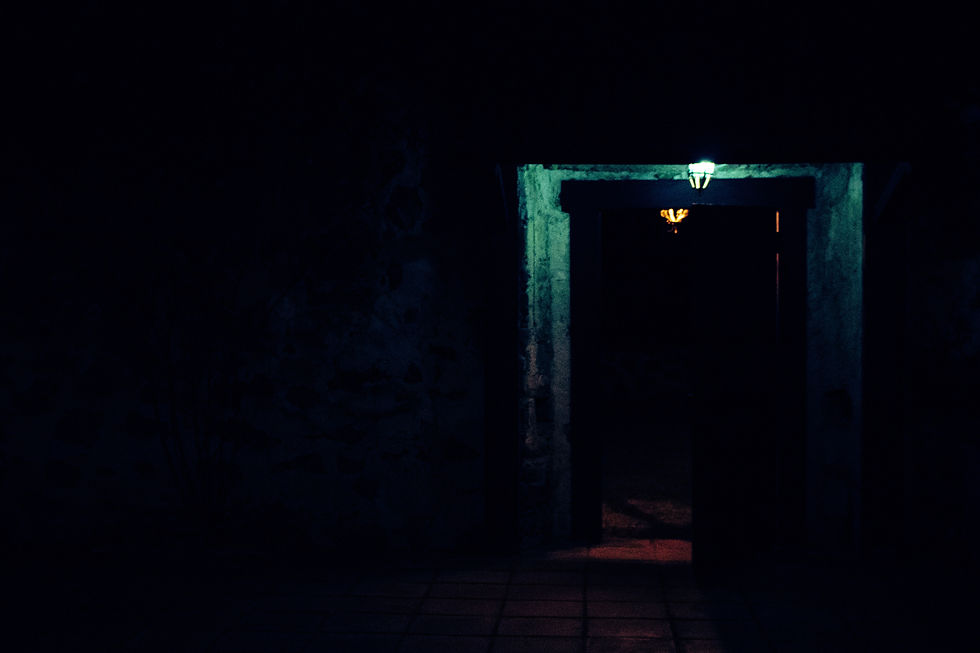
I rubbed my eyes and blinked the quasars out of my vision. Every few minutes, the door to the bar would open; the interior would ignite and then blessedly go dark again. Nobody seemed to recognize me even though I’d grown up here, and it was fine. I was bad company. I wondered if my friend might come in, just to have something to do with the out-of-town guests, but figured they were probably having a thing back at the house—cheese and wine, maybe, or perhaps even a catered dinner; at the very least pizza and salad for whoever still felt like eating—and out of nowhere I thought about the dark doorway in a deep corner of the basement of his childhood home, and recalled immediately the terror I’d felt just being near it, just being within eyeshot of it, as we played on the floor with our He-Man action figures or slid across the carpet in parachute pants. I closed my eyes and could see it, opened them and could still see it. Could feel it. A black portal into the mysterious guts of the house.
I thought I had outgrown the fear, as silly as it was. A doorway in a basement. It was a thing I hadn’t thought about in decades. But lately haunted portals had been appearing to me in my dreams—sometimes as a room in an empty house, sometimes as a hollow in the trunk of a tree on a bright afternoon, sometimes as a sound or a blind vibration. Sometimes as my father, dead now and gone from a terminal case of tough luck. I’d wake up frowning, clouded over. The images always looked different, but I knew in the dreams that they were the same, understood that they came from the same deep place within me. It hadn’t occurred to me before that they were all the dark doorway, looming like Kubrick’s monolith at the foot of my bed, but sitting there in the bar the connection solidified and was so obvious that I laughed.
Six drinks in, and still with hours to kill before my flight, I made a plan. I’d puncture the whole dumb thing by finding the doorway and walking through it.
In my childhood best friend’s former house, I stood alone at the bottom of the basement stairs, gaping into the emptiness. Even in the dark I could tell that nothing had changed. I knelt again and ran my hand across the low-pile woven carpet, remembering how, as kids, we could pull a loose thread and unravel it in long, clean lines.
I took a tentative step into the room. Weak streetlight came in through the windows, narrow like slitted eyes, up near the ceiling, throwing the room’s depth into disarray. I pressed my fingertips to the wall to keep my bearings. Blood pulsed in my temples, my neck. The house was empty but felt pressurized as I moved into the room, like walking on the bottom of the ocean. And then I crested a corner and could see it, the dark doorway leading to another, deeper part of the basement. It gaped black like a missing tooth and I was nine years old, my body filled with concrete and flitting moths.
I stood before the doorway, but didn’t go in. The darkness there was impenetrable—no shimmers of wet light, nothing limned in silhouette. But I knew if I went in what I would find there: a giant twitching heart with its tendrils reaching out like red aortic ropes. In my ears I could feel the heart beating, could hear lifeblood ticking as it pumped through, keeping the house healthy and alive. Pain pulsed through the sore spot near my armpit and I winced. I took a step back. It was clear I’d made a mistake in ever dismissing this fear as childish or irrational—it wasn’t. It had only needed time to grow.
The beating heart chugged and hiccupped. I took another step back, and another. There was nothing left for me to do there.
And then I found myself in my daughter’s bed and it was morning. The sheets next to me were rumpled and empty, the door to her bedroom wide open. From downstairs I could hear the birdsong of my wife and daughter talking, the pop of cooking eggs. Could smell coffee. I sat up, shook the stars out of my head.
I’d gotten in late and hadn’t wanted to wake my wife. She surely would have asked me how everything had gone, and I wouldn’t have known where to begin. But I wanted to see my daughter, so I’d crawled into her bed, put my hand on her warm back as it rose up and down. Gazed at her face, smooshed into the mattress, her deeply breathing mouth the shape of a capital D.
She opened her eyes and smacked the dryness from her lips. “Pops,” she whispered between slow blinks. “Did you fly on an airplane?”
“Yes, my love.”
“Weren’t you scared?”
“What’s there to be scared of, my sweetness?”
She blinked as she considered this, and then her eyes drifted closed and so did mine.
Now awake, I stretched. My body ached in all sorts of ways and at every mark of depth. I’d slept in my contacts; they felt glued to my corneas. I was forty years old. I raised my arm and rubbed the tender spot on my side near my armpit where the doctor had just removed that thing that she hadn’t liked the look of. It stung like a burn. We waited still for the results.
While I’d been gone, my daughter had drawn pictures of her favorite animals and taped them like talismans to her closet door, which we closed up tight every night before bed so that she might sleep soundly and have untroubled dreams. A moody frog with a wide frown. A chicken wearing a hat. From downstairs, her voice plinked and tinged like a wind chime in the breeze. The bed was still warm with her. I thought of my childhood friend, waking up without his mother. I thought about my dad and wondered how many times he had visited me in dreams that I’d forgotten before they were even finished. I thought about Herman’s Hermits, “This Door Swings Both Ways.” In comes the morning sun and then the evening rain.
The hallway outside my daughter’s bedroom was filled with bright sunlight, framed in the open doorway. I got to my feet, let the blood drain from my head, and passed through it.
Joe Squance’s stories have appeared in Best Microfiction 2019, Atticus Review, Cease Cows, Everyday Fiction, Fiction Southeast, and elsewhere, and he has written essays for Salon and Runner’s World. He currently teaches ELA at a small Montessori High School in Oxford, Ohio, where he lives with his spouse and young daughter.